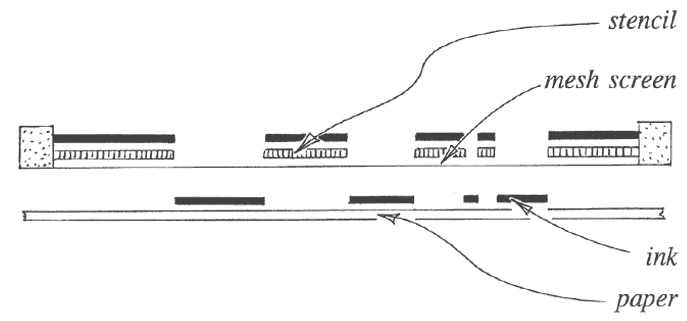
A squeegee is used to force ink through the screen onto the paper beneath. The passage of ink is blocked by the stencil in non-printing areas. Because it is a direct process, the printed image is not reversed as it is in other printmaking techniques.
Screenprints are rarely produced in black and white. They are best known for bold colourful designs. They can also easily be applied to many different surfaces, which makes this a favourite process for popular printing, such as t-shirts.
As well as using hand-made stencils, artists may employ more complex photographic processes. For example, a dot-matrix may be employed to create tonal effects with dots of different sizes when artists develop film images for photographic stencils, through which they print.
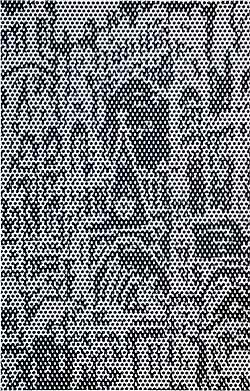 above Roy Lichtenstein, Cathedral (1 of 6 prints after Monet), 119.4x83.8cm. A USA 20th century screenprint. | 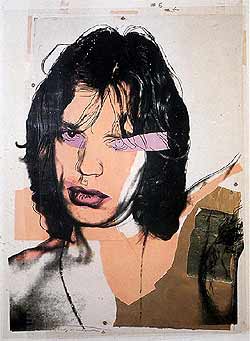 above Andy Warhol, Mick Jagger, Collection of Ludwig Foundation, Austria. A USA 20th century screenprint. |
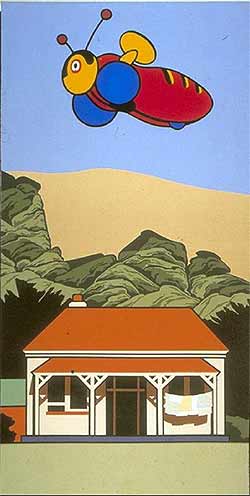 above Robin White, The Buzzy Bee for Siulolvao, 54.6 x 26.7 cm. A New Zealand 20th century screenprint. | 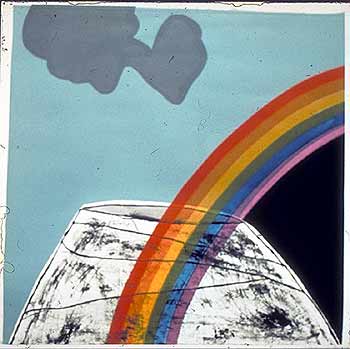 above Patrick Hanly, Rainbow over Mt Eden, Collection of Kim Wright. A New Zealand 20th century screenprint. |