

Page 2 of 5
Read the text and study the images below then move on to page 3.
Drawing
Drawing is often closely associated with painting as many artists made drawings as preparation for paintings. However, drawings can be independent works of art: we know of Michelangelo, for example, making presentation drawings for his friend Vittoria Colonna in the early 16th century.
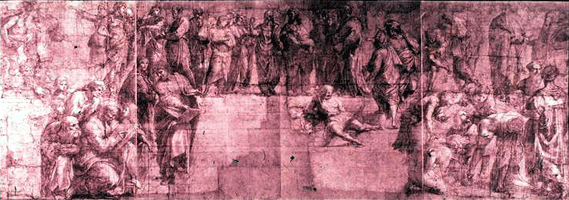
above Raphael, cartoon for School of Athens. Ambrosina, Milan.
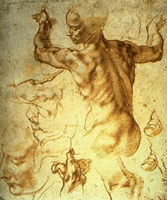
above Michelangelo, sketch for Libyan Sibyl. Biblioteca Medicea Laurenziana, Florence.
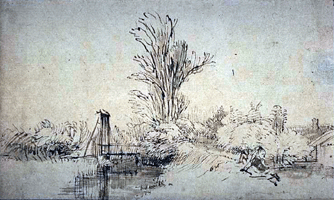
above Rembrandt, Landscape with a Canal and Bridge. Pierpont Morgan Library (USA).
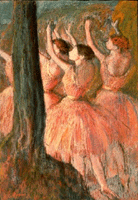
above Degas, Danseuses Roses (Pink Dancers) c. 1895-1900, pastel on paper. Museum of Fine Arts (Boston, Mass.).
Drawings are most often thought of as monochromatic, made in pencil, charcoal or with pen and ink. But they can equally well be coloured, using pencil crayons, chalks or pastel, which combines powdered pigments with gum arabic to make sticks of colour. In the case of the last medium, finished works can have all the richness of an oil painting, as in the works of the Impressionist, Degas. Such works are also a reminder that drawings need not be linear, but can - paradoxically - be painterly if the artist chooses to use the medium that way.